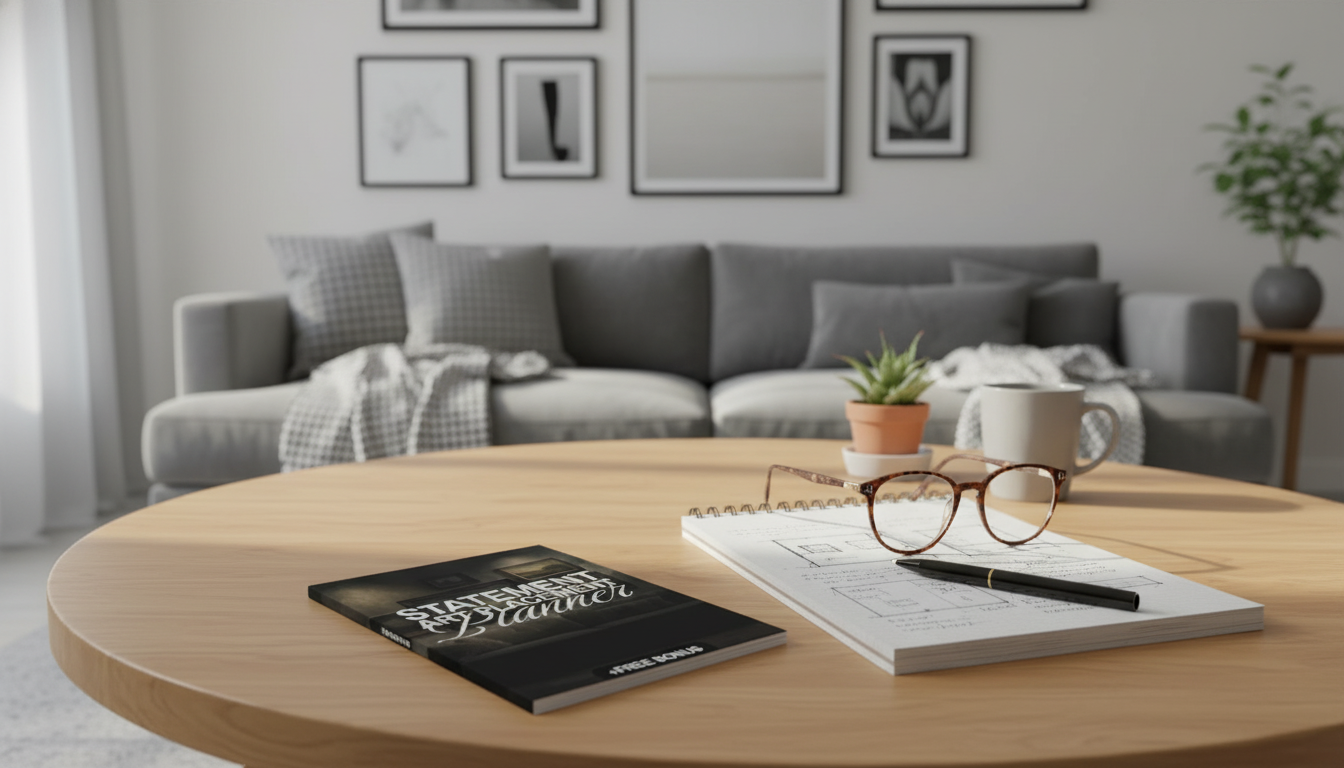
Placing statement art can instantly elevate a room—if the scale, height, and spacing feel intentional. A digital placement planner helps turn a blank wall into a clear plan: map out measurements, test layout options, and refine styling choices before committing to nails or hooks. For anyone who’s ever rehung the same frame three times (or patched “oops” holes), a workflow that combines practical proportions with optional AI-assisted visualization can make the final result feel effortless and polished.
Wall art looks “right” when it relates to its surroundings—especially the furniture line, the room’s sightlines, and any architectural anchors (windows, trim, sconces). A planner makes those relationships visible before you hang anything.
Instead of guessing, you’ll work through a repeatable sequence: pick the visual anchor (sofa, bed, console, or empty feature wall), choose the best layout type, then lock in width, center height, and spacing with simple checkpoints.
The fastest way to upgrade the feel of a wall is to treat art placement like a proportion problem, not a “vibe” problem. Start by measuring the wall and any furniture beneath it, then decide on a target width range and a consistent center height reference. Museums and exhibitions often rely on consistent viewing heights to keep displays comfortable and coherent; the same logic applies at home (see general exhibition guidance at Smithsonian).
| Scenario | Good Starting Point | Why It Works |
|---|---|---|
| Art above a sofa/console | Art width ~60–75% of furniture width | Feels anchored without looking undersized or floating |
| Center height for a single piece | Center around 57–60 in (145–152 cm) from floor | Matches typical eye level for comfortable viewing |
| Gap between frames in a grouping | 2–3 in (5–8 cm) between frames | Reads as one composition, not scattered pieces |
| Distance above furniture | 6–10 in (15–25 cm) above the top of furniture | Connects art to the vignette while keeping it breathable |
| Large statement piece on an empty wall | Go larger than “safe” if the wall is expansive | Prevents the wall from overpowering the art |
Layout is the “shape” your wall reads from across the room. Choose the format that matches both your space and your tolerance for detail.
A helpful rule: if the room already has strong patterns (rug, drapery, wallpaper), a simpler layout often reads more elevated; if the room is quiet and minimal, a layered gallery can add depth without adding clutter.
AI visualization works best as a preview tool—something that narrows choices before you commit. The goal isn’t perfection; it’s confidence that the scale and placement make sense in context.
If you’re building a focal wall, consider how the eye will land when entering the room. Understanding focal attention and where people naturally scan can help you decide whether the art should be centered, offset, or anchored to furniture (research and resources at Getty Research Institute).
Statement Art Placement Planner (Digital Guide)
A reliable baseline is to hang the piece so the center sits around 57–60 inches from the floor. Adjust when placing art over furniture (often a bit lower), with tall headboards, very high ceilings, or when aligning to strong architectural features like window tops or built-ins.
A common guideline is choosing art (or a grouped layout) that’s roughly 60–75% of the furniture width. Go closer to 75% for a bolder statement, and closer to 60% for a lighter look; larger mats and thicker frames also increase the art’s visual “presence.”
It’s best used as a preview rather than a perfect guarantee. Accuracy improves with straight-on photos, consistent lighting, and scaling the mockup using real measurements, then validating the final placement with paper templates or painter’s tape before hanging.










Leave a comment